|
| [6.19] | [6.18] | [6.17] | [6.16] | [6.15] | [6.14] | [6.13] |
| June 19, 2002 |
 |
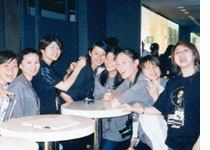 Last day of the festival: there’s a mix of relief and sadness among everyone.
“This week just flew by, didn’t it?” Doug Williams said as we went into one program
and out of another at break-neck speed. Indeed, it’s hard to imagine, almost,
that we got off a plane after an 11-hour flight last week and we’re now about
to take that long flight back tomorrow.
Last day of the festival: there’s a mix of relief and sadness among everyone.
“This week just flew by, didn’t it?” Doug Williams said as we went into one program
and out of another at break-neck speed. Indeed, it’s hard to imagine, almost,
that we got off a plane after an 11-hour flight last week and we’re now about
to take that long flight back tomorrow.
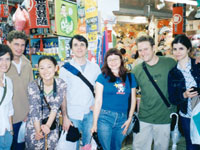 It’s been a fantastic festival, and a wonderful experience. For those of us planning
the event, it’s an amazing feeling of accomplishment to see it happen. Filmmakers
repeatedly told us they thought this is the best organized film festival they have
attended so far, and that our scheduling allowed them both the chance to explore
Tokyo and to get to know each other. You guys have no idea what we did to put it
all together! And we’d do it all over again. Seriously.
It’s been a fantastic festival, and a wonderful experience. For those of us planning
the event, it’s an amazing feeling of accomplishment to see it happen. Filmmakers
repeatedly told us they thought this is the best organized film festival they have
attended so far, and that our scheduling allowed them both the chance to explore
Tokyo and to get to know each other. You guys have no idea what we did to put it
all together! And we’d do it all over again. Seriously.
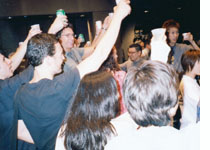 By the end of the last program, filmmakers were rushing to give small gifts to
thank volunteers for their time and help throughout their stay in Tokyo. And in return,
volunteers gave back their thanks for a great time with the filmmakers. One volunteer,
Azusa, who is fluent in Spanish and Portuguese, hand wrote thank-you notes on the back
of hand-painted fans to Lorenza and Liliana their respective languages. “I was really
touched,” Liliana said, of Azusa’s note in Portuguese. For their final hurrah,
the filmmakers, SSFF staff and volunteers shared a drink at Fujimamas in hip little Harajuku.
By the end of the last program, filmmakers were rushing to give small gifts to
thank volunteers for their time and help throughout their stay in Tokyo. And in return,
volunteers gave back their thanks for a great time with the filmmakers. One volunteer,
Azusa, who is fluent in Spanish and Portuguese, hand wrote thank-you notes on the back
of hand-painted fans to Lorenza and Liliana their respective languages. “I was really
touched,” Liliana said, of Azusa’s note in Portuguese. For their final hurrah,
the filmmakers, SSFF staff and volunteers shared a drink at Fujimamas in hip little Harajuku.
|
| June 18, 2002 |
|
|
Rain, rain, go away. We knew, before touching Japanese soil, that our festival was going to fall right in the middle of the rainy season here. Today, it wasn’t just drizzling. It was that hard-hitting, non-stop, downright annoying rain that keeps you inside a building as noisy as LaForet because you just can’t stand the thought of going back outside. And that was good for the first program of the day: Roger Gonin, who started and still heads the Clermont-Ferrand International Short Film Festival in France led a discussion on short French films. In the program: “La Vis,” “Trait D’Union” (which brought a lot of tears to viewers’ eyes), “Compromis” (a good lesson in filmmaking), “Le Puits” and “Hommage a Alfred LePetit.” It was an impressive group of films. Roger talked about how he started the festival, as a sort of cine-club that he and his friends slapped together for friends to enjoy. The festival is now, 25 years later, the largest short film festival in the world. 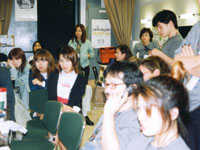 By the afternoon, however, it would be dishonest to say that attention was solely
on short films. in fact, it was anywhere but. The SSFF Staff and volunteers sat
glued in front of a tiny television monitor and watched as Japan fell to Turkey,
1-0. One SSFF staffer ? who shall remain anonymous ? cried. “I was so hoping Japan
would win, you know?” she was heard saying as she ran to the rest room to relieve herself.
Volunteers sat hushed, saddened, angry, hurt…and then, the next program started.
By the afternoon, however, it would be dishonest to say that attention was solely
on short films. in fact, it was anywhere but. The SSFF Staff and volunteers sat
glued in front of a tiny television monitor and watched as Japan fell to Turkey,
1-0. One SSFF staffer ? who shall remain anonymous ? cried. “I was so hoping Japan
would win, you know?” she was heard saying as she ran to the rest room to relieve herself.
Volunteers sat hushed, saddened, angry, hurt…and then, the next program started.
Well, tomorrow’s the last day of the festival. It’s hard to believe the festival’s nearly over! Don’t say so! |
| June 17, 2002 |
|
|
Today was kind of the quiet before the storm. It seems that people are on edge, wondering if Japan’s team, who faces Turkey tomorrow, will pull off another win. Maybe that’s why people were piling into the theatre at LaForet to see some Short Shorts. You know, to get their minds off of soccer, for a while at least. We had a pretty good turnout for our shows, including our late show at the Cinequinto Theatre at Parco Part 3, in the hip area of Shibuya. Mr. Jeon Sooil, head of the Busan Asian Short International Film Festival was there to screen some short films from Korea, including the big hit, Kim Jun Ki’s “The Lighthouse Keeper,” whose surprise ending elicits a lot of sighs in audiences both here and in the U.S. Short films are apparently a big deal in Korea; Mr. Sooil told us that about 400 are made annually, and the numbers are rising. The U.S. defeated Mexico. It might have been interesting to be in L.A. for that one. But tomorrow’s match…it will be interesting. A local news network reported that Japanese companies are shutting down during Japan’s games because employees are sneaking away or calling in sick to watch them. Does that mean they have to work while the TV’s on? |
| June 16, 2002 |
|
|
Another busy day. Director Dean Kapsalis gave us all a scare when he woke up feeling... "pretty sick". Maybe it was some sushi I had? and nearly went to the hospital but decided to wait and see, what, if anything, would happen. Nothing did except that he got better during the course of the day and even appeared at his screening, the last of the day, to take questions about his film "Jigsaw Venus" Dean, what a trooper. Chances are he'll be feeling even better tomorrow. 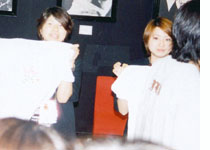 A group that hasn't gotten much mention yet: our volunteers.
What an amazing group of enthusiastic, tireless, and fun people!
Some of them have been selling T-Shirts for our resident Boobie Girl,
and with a lot of luck. "My girls" Brooke Keesling calls them, "are great.
They sold a ton of my T-shirts! So I gave them a commission!" She wouldn't say how much.
A group that hasn't gotten much mention yet: our volunteers.
What an amazing group of enthusiastic, tireless, and fun people!
Some of them have been selling T-Shirts for our resident Boobie Girl,
and with a lot of luck. "My girls" Brooke Keesling calls them, "are great.
They sold a ton of my T-shirts! So I gave them a commission!" She wouldn't say how much.
Meanwhile, when fans get a chance to get their photo taken with our Executive Director Tetsuya Bessho, they do. It's great, how he grants them their wish and how patient he is. And some of those fans are pretty crazed. In a polite way, of course "The SSFF DVDs", compilations of films from the festival in years past, have sold well, but they sell even better when Tetsuya signs them. Hey, anything we can do (well, almost anything) to promote this little festival, helps. And works. 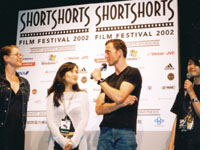 James Allen ("Judge is God" director) was nowhere to be seen today. And understandably.
England soundly defeated Denmark 3-0 in the World Cup yesterday. Had anyone wanted to
play a mean joke on the Englishman, they would have called him very early and told him
that the day's program had changed and he had to be at LaForet before noon.
Ah, soccer fans. You gotta love'them.
James Allen ("Judge is God" director) was nowhere to be seen today. And understandably.
England soundly defeated Denmark 3-0 in the World Cup yesterday. Had anyone wanted to
play a mean joke on the Englishman, they would have called him very early and told him
that the day's program had changed and he had to be at LaForet before noon.
Ah, soccer fans. You gotta love'them.
|
| June 15, 2002 |
|
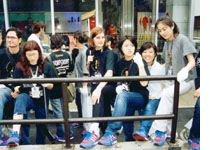 What a day. We started off waiting for our filmmakers and volunteers in front of Laforet.
We were scheduled to start sweeping at 10:00 a.m. but by 10:15 there were still
a few people missing. Were some out late the night before…? Once everyone showed up,
we quickly moved down Omotesando and swept whatever garbage we could find.
Which wasn’t much. It seems that clean-up crews in Tokyo worked fast the night before.
Japanese soccer fans were ecstatic following Japan’s win over Tunisia in the World Cup,
and crowded the streets the night before. Police, by the hundreds, cordoned off sidewalks
and streets in order to control the crowds. But one would have never guessed that
any partying had taken place the night before, given the clean state of the streets.
What a day. We started off waiting for our filmmakers and volunteers in front of Laforet.
We were scheduled to start sweeping at 10:00 a.m. but by 10:15 there were still
a few people missing. Were some out late the night before…? Once everyone showed up,
we quickly moved down Omotesando and swept whatever garbage we could find.
Which wasn’t much. It seems that clean-up crews in Tokyo worked fast the night before.
Japanese soccer fans were ecstatic following Japan’s win over Tunisia in the World Cup,
and crowded the streets the night before. Police, by the hundreds, cordoned off sidewalks
and streets in order to control the crowds. But one would have never guessed that
any partying had taken place the night before, given the clean state of the streets.
And yet, despite all this soccer on people’s brains, many still took the time out to see our festival’s films. Every screening today was full! And audiences were truly delighted to see some of the films’ directors and get their perspectives on filmmaking. 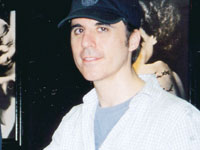 One of the key moments of the day: during the screening of Program D, a woman personally
thanked director Dean Kapsalis for making “Jigsaw Venus.” “I have struggled with
my appearance and how I feel about myself for a very long time,” the woman said.
She felt that watching the woman in the film go from feeling terribly inferior about
herself to confident and humorous was inspiring. “Thank you so much for making this film.”
Dean was speechless.
One of the key moments of the day: during the screening of Program D, a woman personally
thanked director Dean Kapsalis for making “Jigsaw Venus.” “I have struggled with
my appearance and how I feel about myself for a very long time,” the woman said.
She felt that watching the woman in the film go from feeling terribly inferior about
herself to confident and humorous was inspiring. “Thank you so much for making this film.”
Dean was speechless.
|
| June 14, 2002 |
|
|
The festival got off to a really interesting start, a panel discussion of whether one's nationality plays a part in filmmaking. Although the discussion was a bit long and veered off the main topic, it was very interesting. Obviously, nationality, does play a part in films. We may not realize it right away, but it's what makes a Greek film different from a Brazilian, or Mexican, or American film. By one p.m. the lines up to the entrance of the festival were getting longer and longer. It was obvious that people were getting impatient to get inside and see this year's films. How exciting! After all the hard work the festival's committee and staff put into first finding the films, selecting the films and then getting the films into the festival, it felt like the work was really paying off. And the best part was seeing such a good turnout against the backdrop of the World Cup. Everyone's talking soccer in Tokyo! And with good reason: we found out late in the afternoon that Japan's team, who were not expected to make it to the second round, had just defeated Tunisia, 2-0. The streets of Tokyo erupted into euphoric parades of soccer fans, waving Japan's flag. It was only appropriate, then, that Program B started with Paulo Machline's "Uma Historia de Futebol," a retrospective story about a man who grew up playing soccer in Brasil with a boy he nicknamed 'Dico,' and who later became the sport's most legendary player, Pele. Salamo Levin, director of the comedy, "Black People Hate Me and They Hate My Glasses," noted that the festival programs were a really good mix of all genres. "I felt that the films in my programs took me everywhere. I laughed, I cried." The documentary "Tsipa and Volf," directed by Michael Gamburg, about his immigrant grandparents, brought tears to audiences' eyes. Tomorrow, we sweep the streets of Tokyo (well, not really, just Omotesando, where the festival screenings take place), part of a deal the festival has with the city. In exchange for letting us put up our festival banners along the street to advertise the festival, we keep the streets clean. It's an annual ritual called Sweepers. Sure hope the weather holds up! |
| June 13, 2002 |
|
|
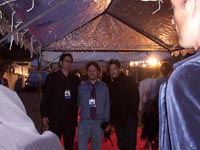
What a day. After a leisurely breakfast at the ANA Hotel in Akasaka (where most of the invited filmmakers and staff are staying during the festival), we quickly zipped off to the famous Meiji Shrine to receive an official blessing for the success of our festival. We wondered, as we walked through some light drizzle down the gravel path to the ceremonial hall, if the weather would get any worse today. It's rainy season here in Japan, and although Tokyo hasn't had intense thunderstorms yet, we wondered…maybe the priests performing our blessing ceremony today would also pray for good weather? The blessing was beautiful. It lasted about half an hour. Several priests chanted and sang in their prayers for the success of our festival. Several women, dressed in beautiful kimonos, performed traditional dances to the chants of priests, while we shifted in our seats, unable to kneel throughout the entire ceremony. Once the ceremony was over and we regained feeling in our legs, we took a short walk through the famous Iris garden of the shrine, where we learned that over 300 different types of irises are in full bloom. About 8700 individual irises are currently in the garden. We then made our way to the famous Gonpachi restaurant in Nishi Azabu, a ritzy part of Tokyo known for its fabulous restaurants, clubs and expensive expatriate residences. Gonpachi has pretty much been a household name for a while in Tokyo, but it has gained renewed interest after a recent visit by U.S. President George W. Bush during his state visit to Japan. The food is great: we had some of the most delicious potato croquets, deep fried shrimp, yakitori and a flan pudding that is indescribable. Most of us walked back to the ANA hotel for a well-deserved rest before the evening's gala opening party. (Some filmmakers were still working off their jetlag…) Around six, we met with volunteers in the hotel lobby and returned to the Meiji Shrine for the opening party. After walking down the red carpet, past a pile of ice blocks in which the Short Shorts festival logo was uniquely displayed, we walked into the main party area where two beautiful, brand-new BMWs sat on display. A group of women representing J-Phone showed us the company's latest handsets, and we sipped on some bizarre lichee-liquor drink (we're still trying to figure out what that drink was). Seigo Tono, our office manager in Tokyo, narrated footage from our Los Angeles screening in May, after which we watched several of this year's official selections (Lorenza Manrique's 'Aqui no hay remedio,' and Josselin Mahot's 'Glee'). Festival Executive Director Tetsuya Bessho thanked guests for attending, treated us to a screening of a short by Guy Ritchie (starring, who else? Madonna), followed by the introduction of this year's attending filmmakers. Doug Williams and Keiko Takahashi - our other co-founders - announced this year's Short Shorts Grand Prize Winners (Leanna Creel for "Offside" and Liliana Sulzbach for "The Invention of Childhood"). Now, let the festival begin! |
 |
|
|
|
|

|
|
|
|
|