|
| [July 6] [July 7] [July 13] [July 14] [July 19] |
| July 6, 2002 |
 |
| 11:45 | The SSFF starts in Nagoya! |
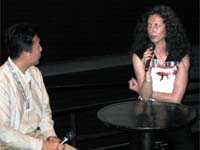 |
In the opening program, Valerie Duvauchelle, a French producer of short films and who is currently active in the film industry in Tokyo,
spoke with Seigo Tono, head of the SSFF Tokyo office, about French short films. Valerie recently worked on promoting the Yokohama French
Film Festival's 10th anniversary here in Japan. She has produced over ten short films herself, and is currently active in promoting
films from all over the world in Japan. According to Valerie, France produces about 500 short films annually, of which roughly 380 are produced by film production companies, and the rest are classified as independent films. "In France, we have a national film center (the CNC) which collects taxes from various sources such as the tax on movie theatre tickets, television programs, and video sales, which it then puts into the support short film production. Local governments and associations also support short filmmakers by giving them breaks on equipment rentals and other materials or services needed. And finally, a lot of filmmakers get help from major companies like Kodak which support them in the form of donations or grants." Yet, despite all of that financial and technical support, not all filmmakers get to utilize all of the support that's available, or, some take somewhat different routes. It's not uncommon for well-known, successful members of the major film industry to lend newcomers a hand. "There are various stages of film production - pre-production (about six weeks), filming (average is about one week), post-production (about three months, even longer) - that are required to make just a short film. Some of these productions are fortunate to have famous filmmakers on board from beginning to end. To have a big name on one's film opens a lot of doors, making it easier to sell the film (to companies that license shorts) or to get it into festivals, and so on. It also, in the end, greatly helps the new filmmaker make it into the major film market, and widen it little by little." |
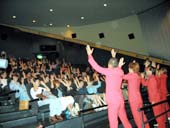
| 18:20 | Screenings start and audiences are delighted! |
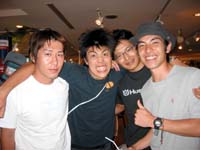 |
These four guys couldn't wait to tell us what they thought. Kobe (far right) said he had come to see a short film starring
Ewan MacGregor two years ago when the festival was still known as the American Short Shorts Film Festival and has since been
following the short film circuit a lot, encouraging his friends from his office to attend this year's fest with him. "I loved '
Chicken.' I also thought TALLgirl and Dos Mas were great. I felt they were strong stories." Friend Watanabe, third from the right,
also liked "Chicken." "I think sometimes when a story's not so obvious, or you have to really think about what it's telling you,
that's great." Their buddy Matsumoto (far left) said he liked 'Tallgirl' too. "I think short films are great because they say so much in such a short span of time," explained Kobe, while Matsumoto said he liked the mix of films. "There was a great variety in the program, and I felt like I experienced a lot of different things." |
| 20:20 | Reaction to Program D |
 |
This woman - who for some reason decided to remain anonymous - said that she was really moved by Bayram Fazli's "The Well."
The Iranian film "left quite an impression on me. I think that it captured so well what was going on in the characters'
minds, and at the same time their frustration at how they couldn't carry out what they wanted to do," she explained. |
| 20:30 | Okama Ken and his Super Monkeys return! |
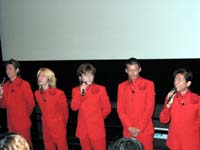 |
A Nagoya-only program: eight films which were unique to Nagoya (either filmed there or had actors or other people closely
related to the city) screened at the festival, and organizers invited those films' participants to talk about their films
during the week. First on the list was "SHA-CHI-HO-KO," the directorial debut of actor Yakusho Koji (star of 'Shall we Dance?'). He told audiences that the film was shot completely on location in Nagoya, and most of the actors in the film were also Nagoya natives. He added that he was so pleased to screen the film at the festival which he described as 'fantastic.' Okama Ken and his Super Monkeys (a five-man entertainment group) from Nagoya was also there to greet the members of the audience, many of whom were big fans and shouted with excitement at the site of Ken and his men. Ken told the crowd what it's like to work in films: "For the scenes I shot, there were usually about 40 people working with me. So, if the scene was no good, we'd have to start all over, me and those 40 people. There is so much pressure on a set. And then there's the great part, getting treating like a movie star. I mean, there was a guy who would hold a parasol over me when I was waiting outside. (laughs)" |
|
 |
|
|
|